Barcelona at Christmas and New Year
Nativity markets outside the cathedral, twelve grapes at midnight, a parade of kings on 5 January, and one very unusual Catalan Christmas tradition.
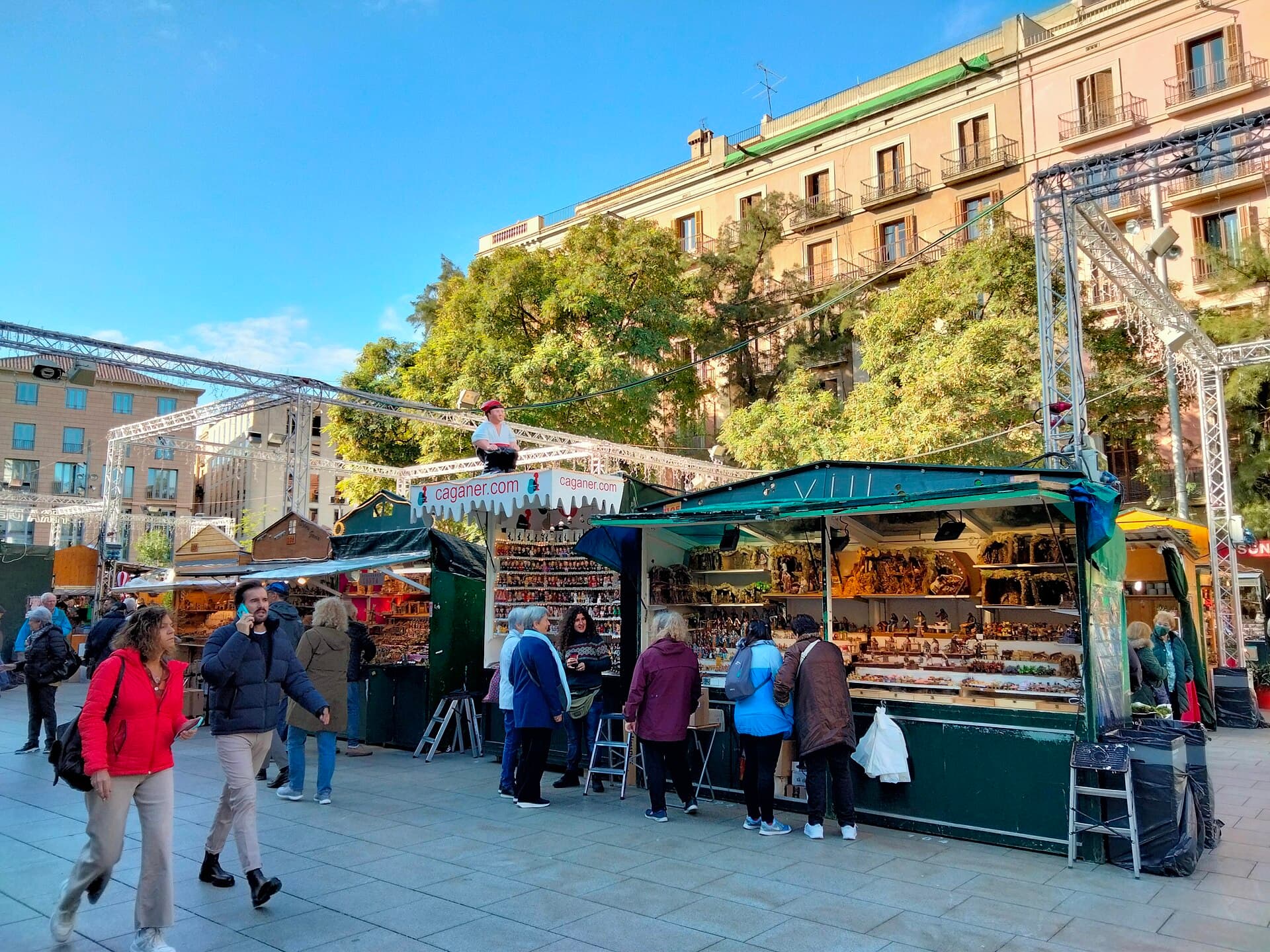
Photo: Enric · CC BY 4.0 via Wikimedia Commons
Catalonia keeps Christmas differently from most of Europe, and differently from the rest of Spain. The season runs from the first week of December to 6 January, the main gift-giving day is not the 25th, and two of the central traditions involve a log and a figurine that visitors tend to find difficult to believe until they see them.
Things to do in Barcelona at Christmas and New Year
- Browse the Fira de Santa Llúcia nativity market outside the cathedral
- Buy a caganer and a Tió de Nadal log, the two Catalan oddities
- Walk the Passeig de Gràcia illuminations on a weekday evening
- Eat the twelve grapes at midnight at Plaça Espanya
- Watch the Three Kings arrive by sea on 5 January
- Order escudella on the 25th and canelons on Sant Esteve
Each of these is covered in detail below.
The Christmas markets
Fira de Santa Llúcia
Held in the square in front of the cathedral since 1786, running from late November to 23 December. It is a nativity market above all — hundreds of stalls selling figures for the pessebre, the nativity scene that most Catalan households build at home, alongside greenery, decorations and hand-carved wooden goods.
The caganer
Somewhere in every Catalan nativity scene, tucked behind the stable, is a small figure of a peasant with his trousers down, squatting. This is the caganer, and he has been part of the tradition since at least the eighteenth century, understood as a symbol of fertilising the earth for the coming year. Market stalls now sell versions depicting politicians, footballers and celebrities. Buying one is a genuine local custom, not a tourist joke.
The Tió de Nadal
The other tradition that startles visitors: a hollow log with a painted face and a red hat, which children feed and cover with a blanket through December, then beat with sticks on Christmas Eve while singing a song instructing it to produce sweets. It duly does. Logs are sold at every Christmas market.
Other markets
The Fira de Nadal at Sagrada Família is smaller and sits directly under the Nativity façade. In Gràcia and Sants, neighbourhood markets are less polished and more local.
New Year's Eve
The twelve grapes
At midnight on 31 December, across Spain, everyone eats twelve grapes — one on each chime of the clock. Getting all twelve down in time is genuinely difficult and that is the point. Supermarkets sell tins of twelve peeled, deseeded grapes for the purpose, which feels like cheating but is widely used.
Most people do this at home or in a restaurant with family. The public gathering in Barcelona is at Plaça Espanya, in front of the Magic Fountain, with a light and music show and, in most years, fireworks.
Dinner on the 31st
Nochevieja dinner is a serious fixed-menu affair and restaurants book out well in advance, often weeks. If you want to eat out on 31 December, arrange it early. Many venues then continue into a cotillón — a party with drinks and breakfast churros at dawn.
New Year's Day
1 January is very quiet. Most shops, many restaurants and most attractions are closed, and the city wakes up slowly. Plan a walk rather than a museum.
Three Kings — the main event
For Catalan children, presents arrive on the morning of 6 January from the three Magi, not from Father Christmas on the 25th. The evening before is the biggest street event of the Barcelona year.
The Cavalcada dels Reis
On 5 January the Kings arrive by sea at Port Vell, are formally handed the key to the city, and then process through the centre on elaborate floats with a cast of hundreds, throwing sweets to the crowds. It runs for several hours in the evening and draws enormous numbers of families.
If you are in Barcelona in early January with children, this is the thing to see. Arrive early along the route and expect the streets to be extremely full.
Roscón de Reyes
On the 6th, families eat a ring-shaped cake decorated with candied fruit, with a small figurine and a dried bean hidden inside. Whoever finds the figurine is crowned; whoever finds the bean traditionally pays for the cake.
Christmas food
Christmas lunch on the 25th traditionally starts with escudella i carn d'olla — a broth served with large pasta shells called galets, followed by the meat and vegetables that were boiled to make it, brought out as a second course. It is a two-part dish and a whole afternoon.
On 26 December, Sant Esteve, the leftovers are reworked into canelons, Catalan cannelloni. This is not a lesser meal — for many families it is the better of the two days, and it is the reason Sant Esteve is a public holiday in Catalonia and nowhere else in Spain.
Turró and neules
The sweets of the season: turró, nougat made with almonds and honey, in hard and soft varieties, and neules, thin rolled wafers eaten with cava. Every supermarket carries walls of both from late November.
What is open, and when
25 December, 26 December (Sant Esteve, a public holiday in Catalonia but not in the rest of Spain), 1 January and 6 January are the days when the city substantially closes. Museums, most shops and many restaurants shut. Between those dates the city runs more or less normally and the shopping streets are busy.
The weather
Typically 8 to 15 degrees, often sunny, occasionally wet. Cold enough for a proper coat in the evening, mild enough to spend the day outdoors. Barcelona apartments and older restaurants are frequently under-heated by northern European standards, so layers are more useful than a single heavy coat.
The lights
The Christmas illuminations go up in late November and run to 6 January. Passeig de Gràcia, Portal de l'Àngel and the streets of Gràcia are the best of them, and the switch-on evening at the end of November is an event in itself. Unlike the markets, the lights cost nothing and are at their best on an ordinary weekday evening when the shopping crowds have thinned.
Getting around over the holidays
Public transport runs reduced schedules on 25 December and 1 January, though the metro usually runs all night on New Year's Eve. Taxis on the night of 31 December are close to impossible to find between about half past midnight and three in the morning — this is the single most difficult night of the year to get a car in Barcelona.
If you have a flight, a fixed dinner reservation, or a plan that depends on being somewhere at a particular time over New Year, book transport in advance rather than assuming you will find something.
Book your transfer to Barcelona City
Private, door-to-door, with a fixed price agreed before you travel.