Sitges: Beaches, Carnival and the Garraf Coast
Seventeen beaches, a whitewashed old town built around a sea-facing church, and the most theatrical carnival in Catalonia — all 35 km from Barcelona.
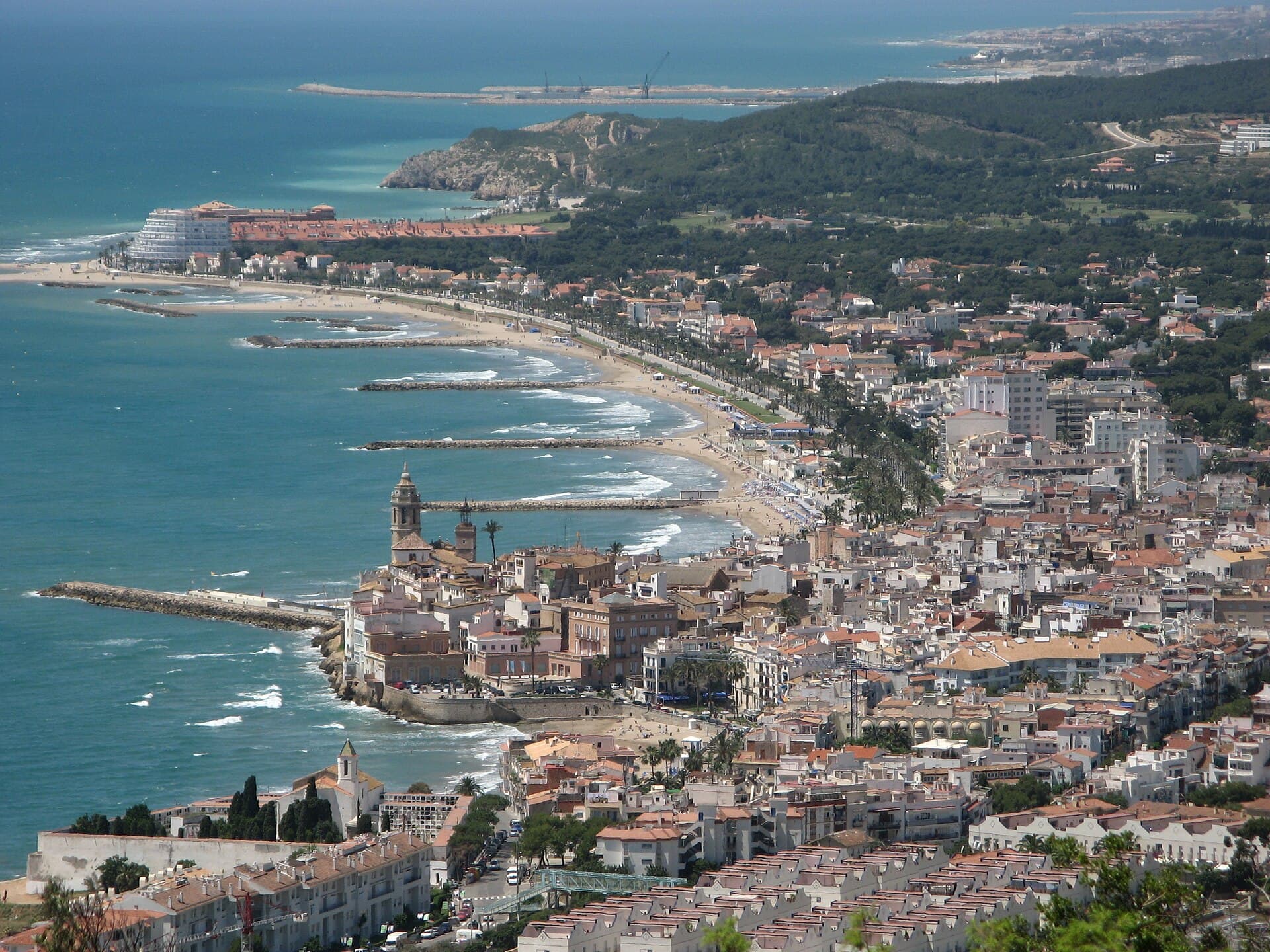
Photo: Werner Lang (Wela49) · CC BY-SA 3.0 via Wikimedia Commons
Sitges sits on the Garraf coast about 35 kilometres southwest of Barcelona, close enough for a morning departure and far enough that the city drops away completely. The approach is part of the appeal: the road runs between the Garraf massif and the Mediterranean, limestone hills on one side and open water on the other, before the town appears as a cluster of white buildings around a church on a rocky promontory.
It is a small town with an outsized personality. Sitges has been an artists' colony, a fishing port, a Bacardí family hometown, and for decades one of the most openly welcoming resorts in southern Europe. All of those layers are still visible if you walk it properly.
Why Sitges is worth the trip
Plenty of towns along this coast have good beaches. What Sitges has that most do not is a genuine old quarter that was never flattened and rebuilt during the tourism boom. The narrow streets behind the seafront are still the original street plan, and the buildings around them belonged to americanos — Catalans who made money in Cuba and the Americas in the nineteenth century and came home to build extravagant houses with it.
The result is a town where you can spend the morning in a museum full of wrought iron and modernist painting, the afternoon on sand, and the evening at a restaurant table twenty metres from the water. Very few places compress that range into a walkable centre.
What to do in Sitges
The old town and the church of Sant Bartomeu
Start at the church. Sant Bartomeu i Santa Tecla stands on a rock above the sea and is the image that appears on every postcard of the town, but the reason to climb up to it is the view back down: the curve of the beaches on one side, the marina on the other, and the terracotta roofs of the old quarter behind. It takes ten minutes and orients you for everything else.
From there, walk down into the lanes behind. They are narrow, whitewashed, hung with bougainvillea, and almost entirely free of traffic. This is where the town feels least like a resort and most like an ordinary Catalan coastal settlement that happens to be extremely good looking.
The beaches
Sitges has seventeen beaches spread over roughly four kilometres of coast, which means the character changes considerably depending on where you stop.
Platja de la Ribera and Platja de Sant Sebastià
These are the central beaches, immediately below the promenade. Ribera is the wide, busy one with the full run of loungers and beach bars behind it. Sant Sebastià, tucked on the other side of the church headland, is smaller, quieter and more popular with local families. If you are visiting with children, Sant Sebastià is the better choice.
The quieter beaches further out
Walk southwest along the promenade and the crowds thin quickly. Beaches like Terramar and Les Anquines are longer, less developed and considerably calmer even in August. It is a fifteen to twenty-five minute walk from the centre, which is enough to deter most day visitors.
Museums worth an hour
Cau Ferrat was the home and studio of the painter Santiago Rusiñol, a central figure in Catalan modernism, and he filled it with ironwork, ceramics, glass and paintings — including work by El Greco. Next door, Palau Maricel is a sequence of rooms and terraces built into the cliff with sea views through the arches. The two connect, and together they take about ninety minutes.
There is also Casa Bacardí, in the old market building, which traces the story of Facundo Bacardí — born in Sitges, emigrated to Cuba, founded the rum company. It is more entertaining than it sounds and ends with a cocktail.
When to visit
Carnival, in February
Sitges Carnival is one of the largest and most flamboyant in Spain. It runs for about a week before Lent and centres on two enormous night parades, with elaborate floats, choreographed groups and a town that does not sleep. If you want the spectacle, this is the week. If you want a quiet weekend by the sea, choose almost any other week of the year.
High summer
July and August bring the reliable Mediterranean pattern: hot, dry days, warm sea, and a town operating at full capacity. Book restaurants and accommodation well ahead. Arrive in the morning if you want a good spot on the central beaches.
October and the Film Festival
The Sitges Film Festival specialises in fantasy and horror cinema and has become one of the most respected genre festivals anywhere. It fills the town in October, when the weather is still mild and the sea is still swimmable. For many people this is the best compromise between atmosphere and comfort.
The quietest months
May, June and late September are the sweet spot. The sea is warm enough, the terraces are open, and you can walk the old town without queueing.
Eating and drinking
Sitges is a seafood town. Xató is the local dish worth seeking out — a salad of endive, salt cod, tuna and anchovies dressed with a rich almond and hazelnut sauce, closer to romesco than to anything you would call a salad elsewhere. It is a winter dish traditionally, but many restaurants serve it year round.
The Garraf region also produces Malvasia, a sweet white wine with a long history in the town. It is not widely exported, so this is the place to try it.
Practical tip
The restaurants directly on the seafront promenade charge a premium for the view. Walk two streets back into the old town and both the prices and, generally, the cooking improve.
Getting to Sitges from Barcelona
Sitges is roughly 35 kilometres from Barcelona city and around the same from El Prat Airport. By car the journey is about 35 minutes on the C-32, which runs through a series of tunnels under the Garraf hills.
Trains run from Barcelona Sants and Passeig de Gràcia and take between 40 and 50 minutes, but you need to get to the station first, and the walk from Sitges station down to the seafront is about ten minutes. With luggage, beach equipment or small children, a door-to-door private transfer removes three separate transitions from the day.
Book your transfer to Sitges
Private, door-to-door, with a fixed price agreed before you travel. From €80 per vehicle from El Prat Airport, excluding VAT and tolls.