Tossa de Mar: The Walled Town on the Costa Brava
A twelfth-century fortress standing directly in the sea, three beaches inside the town, and the cleanest water within easy reach of Barcelona.
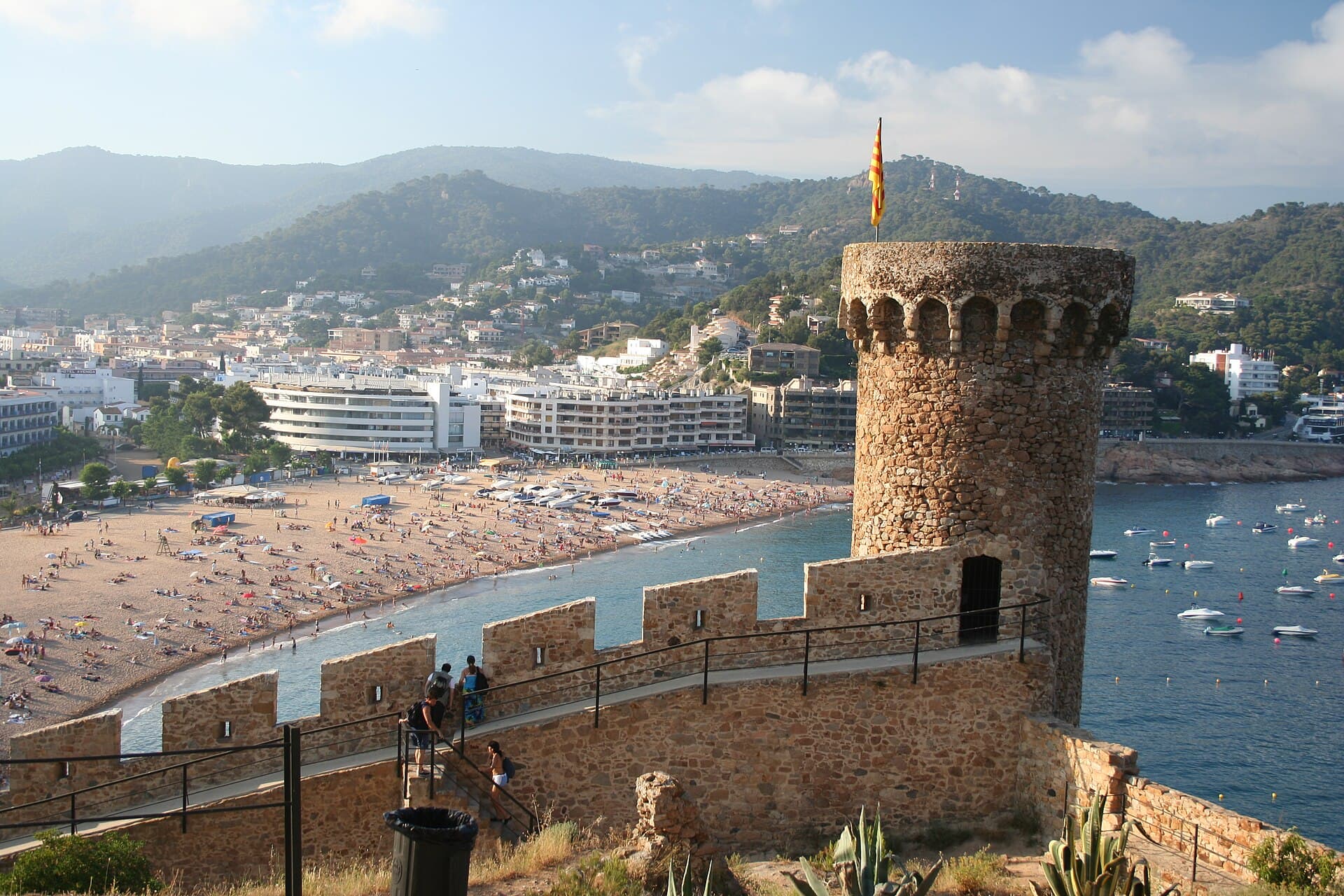
Photo: Unknown · CC BY-SA 2.5 via Wikimedia Commons
Most of the Costa Brava's medieval architecture sits inland, safely back from a coast that spent centuries being raided. Tossa de Mar is the exception. Its fortified old town, the Vila Vella, was built on a headland that drops straight into the water, and it is the only fully walled medieval settlement still standing on the entire Catalan coast.
That single fact is why Tossa looks different from every other resort on this stretch. You approach along the coast road, come around a bend, and there are stone towers rising out of the sea above a curved beach.
Things to do in Tossa de Mar
- Climb through the walled Vila Vella to the lighthouse
- Swim at Platja Gran beneath the medieval towers
- Snorkel the rocks off Mar Menuda
- Walk a stretch of the GR 92 coast path toward Sant Feliu
- Take a glass-bottomed boat to the roadless coves
- Eat cim i tomba, the local fishermen's stew, in the old town
Each of these is covered in detail below.
The Vila Vella
The walls date from the twelfth century and were built against pirate raids from North Africa, which were a genuine and recurring threat on this coast well into the sixteenth century. Three of the original towers survive, along with most of the curtain wall.
Inside, the old town is a small grid of cobbled lanes, mostly given over now to restaurants and small shops but still recognisably medieval in scale. Walk up through it to the lighthouse at the top of the headland.
The view from the top
From the lighthouse terrace you get the whole geography at once: the main beach curving away to the north, the rocky coves to the south, and on a clear day a long stretch of the Costa Brava disappearing into haze. It is a fifteen-minute climb from the beach and it is the reason most people remember Tossa.
Go early or late
The Vila Vella is compact, and between about 11am and 5pm in August it is genuinely crowded. Early morning and the hour before sunset are dramatically better, and the light on the stone is much better too.
The beaches
Platja Gran
The main beach sits directly below the walls — a wide arc of coarse golden sand about 400 metres long, with the old town at one end and the modern town behind. It is the busiest beach and the most photographed, because of what is standing above it.
Es Codolar and Mar Menuda
Es Codolar is the small pebble cove on the far side of the headland, reached by walking through the old town and down. It is quieter, more sheltered, and the water is noticeably clearer. Mar Menuda, at the northern end, is the local favourite — a calm bay popular with families and, because of the rock formations just offshore, one of the better snorkelling spots on this part of the coast.
The coves further out
The coastline either side of Tossa is a sequence of small rocky inlets, most of them reachable only on foot along the coastal path or by boat. Cala Bona and Cala Pola, both a short drive north, are the easiest of these to reach and are considerably quieter than anything in town.
Walking the coast path
The GR 92 long-distance path runs along this coast, and the section between Tossa and Sant Feliu de Guíxols is one of the most spectacular stretches of it. You do not need to do the whole thing: even an hour out and back along the cliffs north of Mar Menuda gets you into pine woods above empty coves.
Wear proper shoes. The path is well marked but genuinely rocky in places, and there is very little shade in the middle of the day.
When to go
Tossa is a summer town, and a large proportion of its restaurants and hotels close between roughly November and March. That makes June and September the best months to visit: the sea is warm, everything is open, and the streets are not full.
A note on August
August is the busiest month by a wide margin, and parking in Tossa is genuinely difficult — the town sits in a bowl with limited access roads. If you are visiting in August, being dropped off and collected is worth considerably more than it costs.
Eating in Tossa
The local speciality is cim i tomba, a fisherman's stew of white fish and potatoes in a garlic and saffron broth, traditionally made with whatever came up in the nets. Several restaurants in the old town make it properly. Beyond that, expect grilled fish, rice dishes and reasonable prices by Costa Brava standards.
Tossa and the artists
In the 1930s Tossa attracted a colony of European painters — Marc Chagall came and called it a blue paradise — and the municipal museum in the old town holds work from that period, including a Chagall. It was the first museum of contemporary art in Catalonia when it opened in 1935.
Two decades later the town got its second dose of fame when Pandora and the Flying Dutchman was filmed here with Ava Gardner. There is a bronze statue of her on the walls looking out to sea, which is either charming or slightly odd depending on your view of statues of film stars on medieval fortifications.
Boat trips
Glass-bottomed boats run along the coast from the main beach in season, linking Tossa with Lloret, Sant Feliu and Blanes. They are the easiest way to see the coves that have no road access, and the hour-long round trip toward Sant Feliu passes some of the most dramatic cliff scenery on the coast.
Getting to Tossa de Mar from Barcelona
Tossa is about 90 kilometres north of Barcelona. The fast route follows the AP-7 motorway and then cuts across to the coast — roughly 75 minutes door to door.
There is a slower alternative worth knowing about: the coast road from Lloret de Mar, the GI-682, is one of the great drives in Catalonia, a genuinely twisting corniche that hangs above the sea for its entire length. It adds about twenty minutes and it is worth every one of them if the weather is clear.
There is no train to Tossa — the railway does not reach this part of the coast. The options are a bus connection via Lloret or Blanes, driving, or a private transfer.
Book your transfer to Tossa de Mar
Private, door-to-door, with a fixed price agreed before you travel. From €155 per vehicle from El Prat Airport, excluding VAT and tolls.