Figueres and the Dalí Theatre-Museum
The largest surrealist object in the world, built by Dalí on the ruins of a burned-out theatre, with the artist himself buried under the floor.
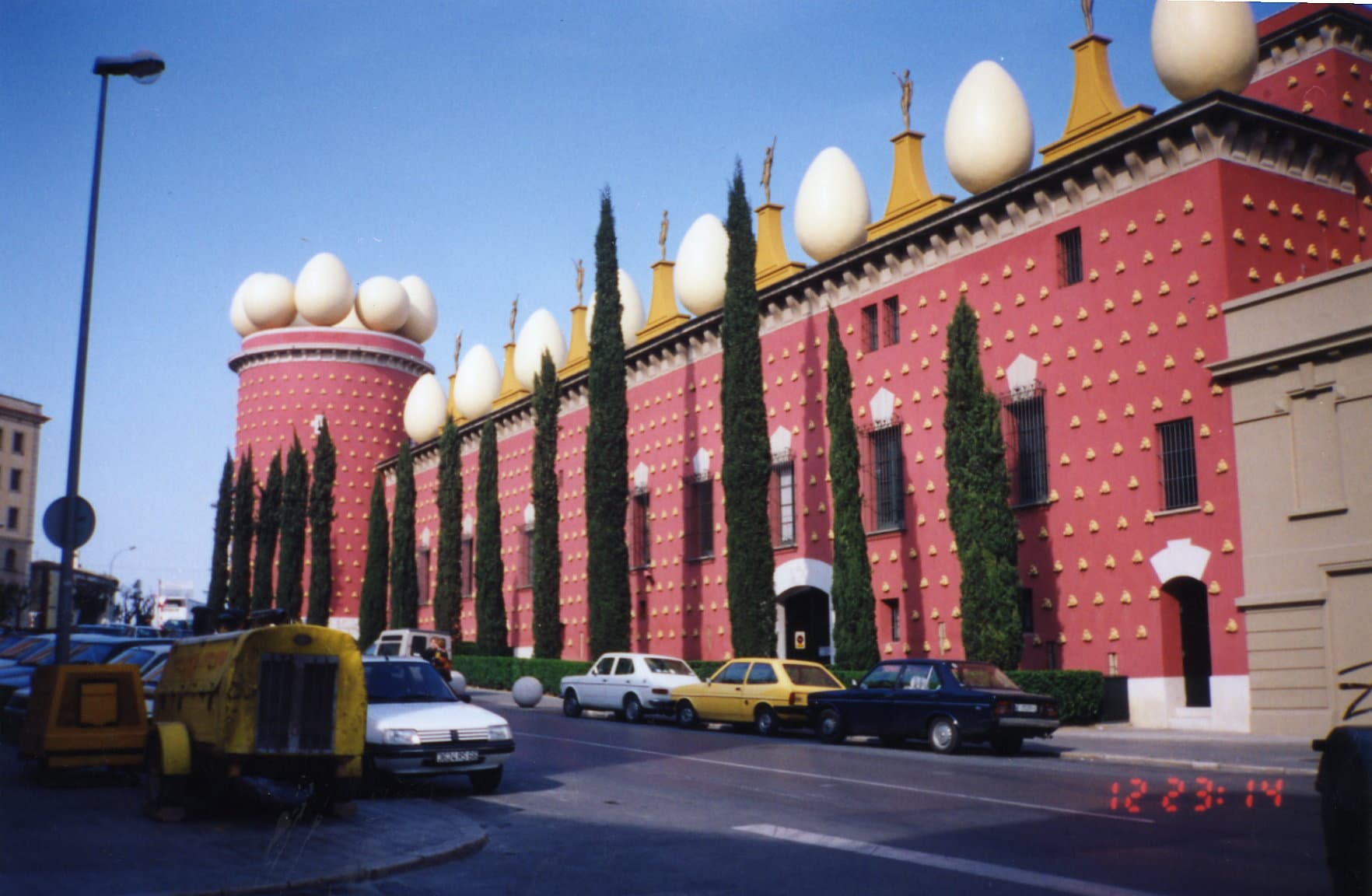
Photo: Andris at English Wikipedia · Public domain via Wikimedia Commons
Salvador Dalí was born in Figueres in 1904, held his first exhibition in the town theatre as a teenager, and in the 1960s persuaded the authorities to let him rebuild that theatre — which had burned during the Spanish Civil War and stood as a ruin for decades — as a museum of his own work.
He described it not as a museum but as a single surrealist object, and that is the correct way to approach it. The building is the exhibit as much as anything hanging in it.
Things to do in Figueres
- Tour the Dalí Theatre-Museum, from the Rainy Taxi courtyard to his crypt
- Climb the viewing lens in the Mae West room
- See the ruby heart that beats in the Dalí·Jewels annexe
- Walk the ramparts of the vast Castell de Sant Ferran
- Browse the covered market for Empordà anchovies and wine
- Eat where Dalí ate, at Hotel Duran on the Rambla
Each is covered below.
The building
You recognise it from a distance: dark red walls studded with what appear to be bread rolls, topped by a line of enormous white eggs and gold figures, with a geodesic glass dome over the old auditorium. None of it is subtle and none of it is accidental.
The courtyard
The old stalls of the theatre are now an open courtyard with a black Cadillac at its centre — insert a coin and it rains inside the car. Above it a boat, said to have belonged to Gala, drips blue tears. It sets the register for everything that follows.
The stage
Under the dome, where the stage was, hangs the vast backdrop Dalí painted for a ballet production. Beneath the floor here is his crypt: he is buried in the building, a few metres from where his first exhibition hung.
What to look for inside
The Mae West room
An entire room built as a three-dimensional trompe-l'œil. From ground level it is a sofa, two paintings and a fireplace. Climb the steps and look through the lens at the top and it resolves into the face of Mae West. There is usually a queue for the viewing platform; it is worth it.
Gala Contemplating the Mediterranean Sea
The double-image painting that, viewed from about twenty metres, becomes a portrait of Abraham Lincoln. The museum provides the distance and, generally, a lens.
The Palace of the Wind ceiling
In one of the upper rooms the ceiling is painted with the enormous soles of two feet, as though Dalí and Gala are standing on the sky above you. It rewards lying on a bench and looking up, which several visitors always are.
The Wind Palace room
Named after a Catalan poem, and painted so that the whole ceiling reads as sky seen from below, with the artist and Gala ascending into it. Dalí regarded it as one of the most personal things in the building.
Dalí·Jewels
An annexe with the same ticket, holding jewellery designed by Dalí — including a heart made of rubies that mechanically beats. Smaller and often much quieter than the main building.
The Rainy Taxi and the Tower Galatea
Two more things not to walk past. The Cadillac in the courtyard is properly titled Rainy Taxi, and the figure inside it, draped in ivy and snails, is soaked continuously by the internal rain — an idea Dalí first staged in Paris in 1938. Outside, the adjoining Tower Galatea is topped with giant eggs and covered in the same bread-roll motif as the main façade; Dalí lived in it during his final years.
Practical planning
Booking
Tickets are timed and sell out in summer. Book online in advance rather than turning up. The museum is closed on Mondays outside the high season, which catches people out — check before you travel.
How long
Two to two and a half hours for the main building and the jewels annexe. It is a dense museum and there is little natural resting point, so pace it.
Night visits
In peak summer the museum runs limited late-night sessions with a glass of cava. Numbers are capped and the atmosphere in the empty courtyard after dark is completely different.
The rest of Figueres
Most visitors see the museum and leave, which is understandable but slightly unfair to the town. Figueres has a pleasant Rambla, a serious food market, and the Castell de Sant Ferran on the hill above — an eighteenth-century bastioned fortress that is one of the largest in Europe, with a perimeter of over three kilometres. It is rarely busy and the scale is remarkable.
The Toy Museum of Catalonia, on the Rambla, is better than it sounds and includes toys belonging to Dalí and to Federico García Lorca.
Eating in Figueres
Figueres sits in the Empordà, one of the strongest food regions in Catalonia, and the town's covered market is the place to see why — anchovies from L'Escala, Empordà wine, local charcuterie and, in autumn, wild mushrooms in quantity.
Hotel Duran, a few minutes from the museum, has been serving traditional Empordà cooking since the nineteenth century and was Dalí's regular haunt; he had his own dining room there. It remains a genuinely good and unpretentious restaurant rather than a shrine.
The Dalí triangle
Three sites make up what the foundation calls the Dalí triangle: the Theatre-Museum in Figueres, the house at Portlligat near Cadaqués, and Gala's castle at Púbol, which Dalí bought for her and was permitted to enter only by written invitation.
Seeing all three in one day is possible but rushed. The usual split is Figueres and Portlligat together — they are about an hour apart — with Púbol on a separate trip.
Getting to Figueres from Barcelona
Figueres is about 140 kilometres north of Barcelona, roughly 100 minutes on the AP-7. The high-speed train from Barcelona Sants to Figueres-Vilafant takes around 55 minutes, though that station is a fifteen-minute walk from the museum; regional trains are slower but arrive in the town centre.
A private transfer makes most sense when combining Figueres with Cadaqués or Púbol, which is the natural way to see the region and which public transport handles poorly.
Book your transfer to Figueres
Private, door-to-door, with a fixed price agreed before you travel. From €200 per vehicle from El Prat Airport, excluding VAT and tolls.