Montserrat: Catalonia's Sacred Mountain
A Benedictine monastery wedged into a wall of serrated rock, the Black Madonna, a boys' choir with a thousand-year history, and walking trails above the clouds.
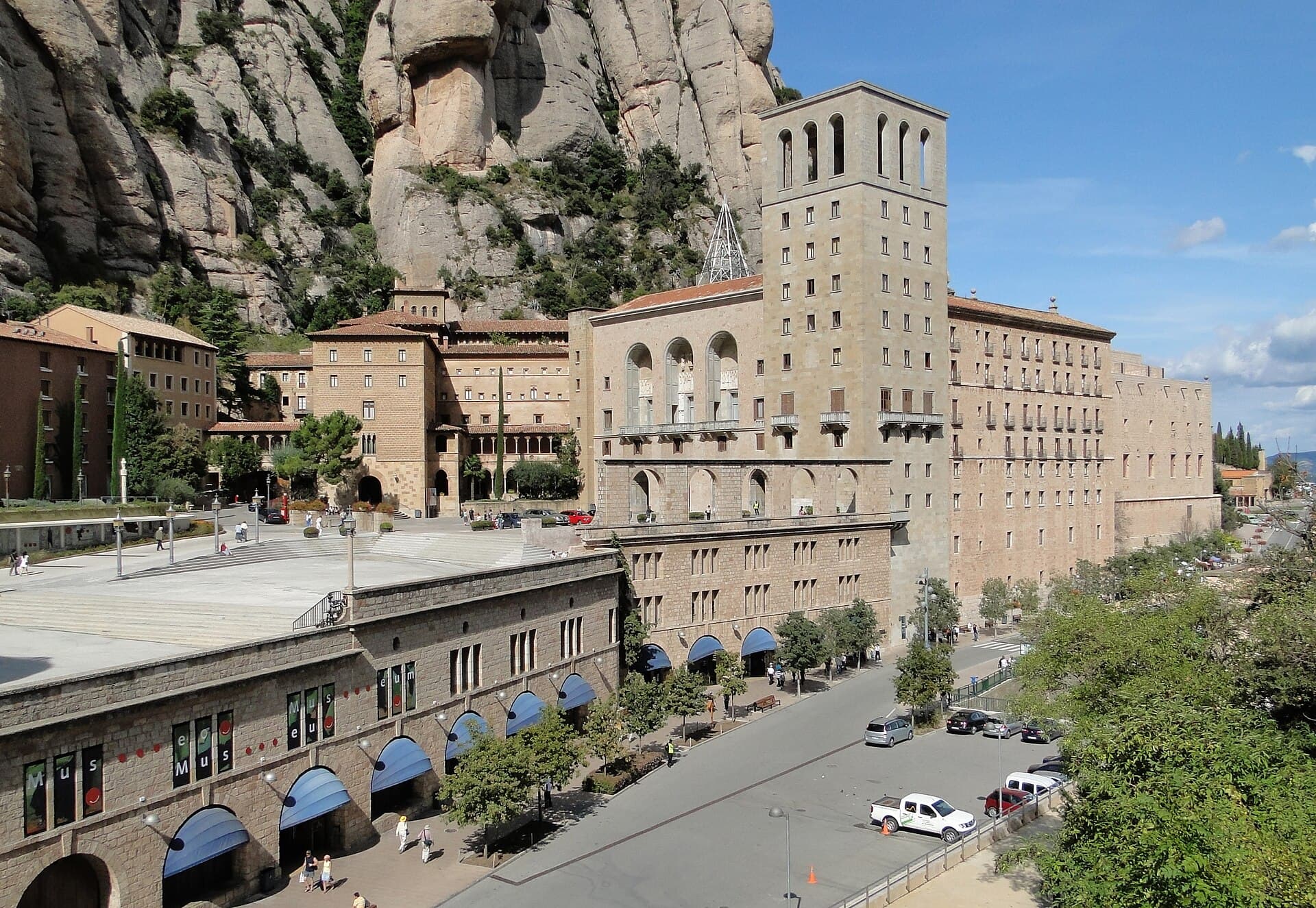
Photo: Bernard Gagnon · CC BY-SA 3.0 via Wikimedia Commons
Montserrat means 'serrated mountain', and the name is a plain description. The massif rises abruptly out of the plain about fifty kilometres northwest of Barcelona, and its upper section has eroded into hundreds of rounded stone columns packed together like organ pipes. Wedged into a ledge halfway up is a Benedictine monastery that has been continuously occupied since the eleventh century.
It is the most visited day trip from Barcelona, and unlike some things that carry that title, it earns it. The setting is genuinely extraordinary and no photograph prepares you for the scale.
Things to do in Montserrat
- See La Moreneta, the Black Madonna, in the basilica
- Hear the Escolania boys' choir sing at midday
- Ride the Sant Joan funicular and walk to the Sant Jeroni summit
- Visit the museum's Caravaggio, Monet and Picasso holdings
- Descend the sculpture-lined path to Santa Cova
- Buy the monks' cheese and honey at the farmers' market
Each is covered in detail below.
The monastery and the basilica
The monastic community here dates to 1025. What you see today is largely nineteenth and twentieth century, because Napoleonic troops destroyed much of the complex in 1811 and it was rebuilt afterwards, but the site itself has been a place of pilgrimage for a thousand years.
La Moreneta, the Black Madonna
The reason for the pilgrimage is a twelfth-century Romanesque wood carving of the Virgin and Child, dark with age and centuries of varnish and lamp smoke, and the patron saint of Catalonia. She sits above and behind the basilica's main altar.
You can queue to walk up a side staircase and pass directly in front of the statue. Tradition is to touch the orb she holds, which protrudes through the protective glass. The queue moves steadily but can be long by late morning.
Go early for this
If seeing the Madonna up close matters to you, be there when the basilica opens. By eleven the queue can stretch well out into the atrium.
The Escolania choir
Montserrat's boys' choir is one of the oldest in Europe, with roots in the fourteenth century. They sing the Virolai and other pieces in the basilica most days during term time, typically at midday, and it lasts only about ten minutes — but hearing that sound in that building is, for many visitors, the moment of the trip.
The schedule varies with the liturgical calendar and school holidays. Check before you plan the day around it.
Beyond the basilica
The museum
The Museu de Montserrat is much better than a monastery museum has any obligation to be. The collection includes work by Caravaggio, El Greco, Monet, Degas, Picasso and Dalí, alongside archaeology and Orthodox icons. An hour is enough; art enthusiasts will want longer.
The funiculars
Two funicular railways run from the monastery level. Sant Joan climbs steeply to the upper mountain and opens up the trail network with the best views. Santa Cova descends toward the chapel built where the Madonna was, by tradition, discovered in a cave.
Walking on the mountain
Most visitors never leave the monastery terrace, which means the trails are far quieter than the site itself. The rock formations have names — the Mummy, the Elephant, the Camel — and walking among them is a completely different experience from looking at them from below.
Sant Jeroni
The summit walk to Sant Jeroni, at 1,236 metres, is the classic route. From the top of the Sant Joan funicular it takes roughly an hour each way on a well-made path. On a clear day the view runs from the Pyrenees to the Mediterranean, and occasionally as far as Mallorca.
Santa Cova
A gentler option: a paved path descending from the monastery, lined with modernist sculpture, including work by Gaudí. About forty minutes down and rather more back up, or take the funicular one way.
What to wear
Proper shoes. The paths are rocky and the mountain is significantly cooler and windier than Barcelona — often by eight to ten degrees. Take a layer even in July.
Practical matters
There is a self-service restaurant, a cafeteria and a small market at the monastery where the monks sell cheese, honey and liqueurs made on site. It is worth stopping at the market even if you do not eat there.
The site is busiest between about 11am and 3pm. Arriving before ten or after three gives you a materially different experience of the same place.
Lighting a candle
In a passage beside the basilica entrance is a long rack of candles kept permanently burning by visitors' offerings. It is one of the more affecting corners of the site — thousands of individual intentions in one place — and it costs very little to add to.
Where the name comes from
The mountain is conglomerate rock: pebbles and gravel from an ancient river delta, cemented together and then lifted and eroded over millions of years into the vertical columns you see. Knowing that changes how the rock reads — those are riverbed stones, thousands of metres in the air.
It also explains the monastery's position. The ledge it occupies is a natural terrace formed where a softer band eroded out, which is why a religious community could establish itself halfway up an otherwise impassable face.
When to visit
Montserrat works year round, which is unusual for a mountain site. Spring and autumn are ideal for walking. Summer is hot on the exposed trails but the altitude keeps it more bearable than the city. Winter is cold and can be misty, but a monastery in cloud has an atmosphere all of its own — and there are far fewer people.
Getting to Montserrat from Barcelona
Montserrat is about 50 kilometres from Barcelona and around 60 from El Prat Airport, roughly 50 minutes by road on the A-2 and C-55.
The public route involves an FGC train from Plaça Espanya to either the cable car or the rack railway, then the final ascent. It is a pleasant journey and the rack railway is genuinely enjoyable, but it takes about ninety minutes each way and runs to a fixed timetable that can constrain your day — particularly the last departures.
By road you arrive directly at the monastery car park, which removes both the connection and the timetable.
Book your transfer to Montserrat
Private, door-to-door, with a fixed price agreed before you travel. From €110 per vehicle from El Prat Airport, excluding VAT and tolls.