Girona: Medieval Walls and the Jewish Quarter
One of Europe's best-preserved Jewish quarters, a cathedral with the widest Gothic nave in the world, and coloured houses reflected in the Onyar.
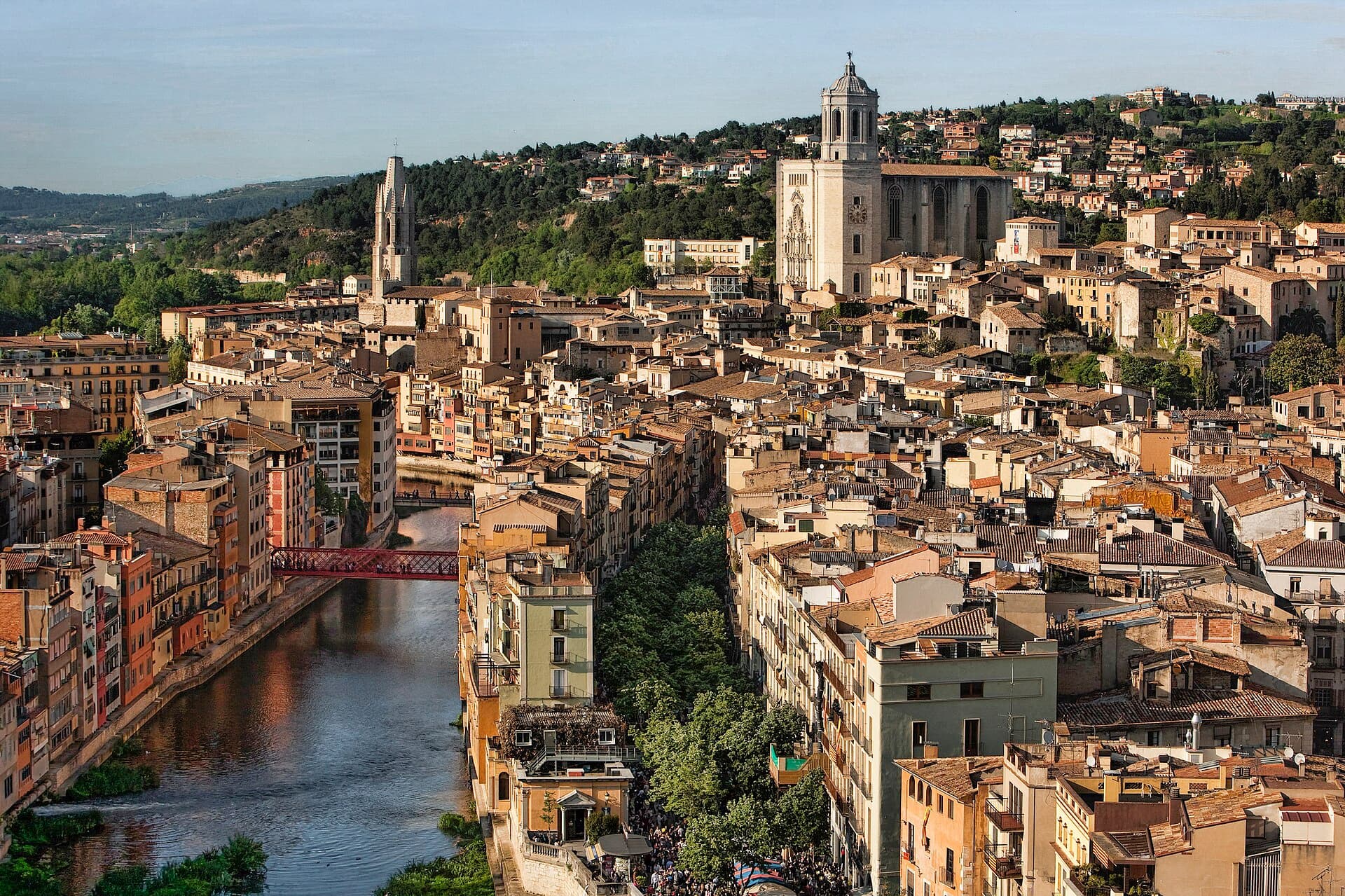
Photo: Patronat de Turisme Costa Brava Pirineu de Girona · CC BY-SA 3.0 via Wikimedia Commons
Girona is a hundred kilometres north of Barcelona, built where four rivers meet, and it has been fortified, besieged and rebuilt so many times that its old town is effectively a cross-section of two thousand years of construction. Roman walls underpin medieval ones. A Gothic cathedral sits on a Romanesque church that sat on a mosque that sat on a Roman temple.
It is compact enough to see properly in a day and dense enough that you could spend three.
Things to do in Girona
- Get lost in El Call, one of Europe's best-preserved Jewish quarters
- Climb the ninety steps to the cathedral and its record-breaking nave
- Walk the Passeig de la Muralla along the old city walls
- Photograph the coloured Onyar houses from the iron footbridge
- See the twelfth-century Arab Baths
- Try xuixo, the cream-filled pastry invented in the city
The rest of this guide takes each in turn.
El Call, the Jewish quarter
Girona had one of the most important Jewish communities in medieval Iberia, and its quarter — El Call — is among the best preserved anywhere in Europe. The community lived here for roughly six hundred years until the expulsion of 1492.
What survives is a warren of extremely narrow stone lanes, some barely shoulder-width, connected by covered passages and steep stairways. It is the most atmospheric part of the city and it is easy to get pleasantly lost in, which is the correct way to experience it.
The Museum of Jewish History
Housed in what was the last synagogue, the museum covers the community's scholarship, daily life and eventual expulsion. Girona was a significant centre of Kabbalistic study, and that thread runs through the collection. Allow an hour.
The cathedral
You approach up a baroque staircase of ninety steps, which is deliberately theatrical and works. The building above it is a mixture of Romanesque, Gothic and baroque, built over five centuries.
The nave
The single Gothic nave is 22.98 metres across — the widest in the world, and the widest of any style except St Peter's in Rome. The medieval masons argued about whether it could be built at all. Standing under it, the absence of interior columns is genuinely striking.
The Tapestry of Creation
In the cathedral treasury is an eleventh-century embroidered hanging depicting the creation of the world — one of the most important surviving Romanesque textiles in Europe. It alone justifies the treasury ticket.
The Game of Thrones connection
The cathedral steps and several streets in the old town were used as filming locations. If that interests you, the tourist office has a map; if it does not, you will not notice, and the city is entirely unchanged by it.
Three more buildings worth finding
The Arab Baths
Despite the name these are twelfth-century Christian baths built in a Moorish style, and they are among the best-preserved Romanesque civil buildings in Catalonia. The central changing room, with its ring of slender columns supporting a lantern that lights the pool below, is a genuinely beautiful piece of architecture and takes twenty minutes to see.
Sant Pere de Galligants
A twelfth-century Benedictine monastery just outside the old walls, now holding the archaeological museum. The cloister is the reason to go — carved capitals in excellent condition, and almost always empty compared with the cathedral.
Sant Feliu
The collegiate church below the cathedral, distinguished by a truncated bell tower — it lost its spire to lightning in the eighteenth century and was never rebuilt — and by eight Roman and early Christian sarcophagi set into the walls of the chancel.
Walking the walls
The Passeig de la Muralla runs along the top of the old city walls, largely Carolingian in origin with substantial medieval rebuilding. You can walk a long stretch of the eastern side, climbing through several towers, and the view takes in the cathedral, the tiled roofs of the old town and the hills beyond.
It takes about an hour end to end. There is very little shade and a fair number of steps.
The Onyar houses
The image of Girona that appears on everything is the row of houses built directly onto the river wall, painted in ochre, red and yellow, seen from the Pont de Pedra or the red iron footbridge designed by the Eiffel company. It is worth crossing both bridges — the reflections are best in the morning when the water is still.
The Rambla and the riverside
The Rambla de la Llibertat, arcaded and lined with cafés, is where the city actually spends its evenings. On Saturday mornings it fills with a flower and produce market that has been held for centuries.
Eating in Girona
Girona has a serious food reputation, anchored by El Celler de Can Roca, which has twice been ranked the best restaurant in the world and books out roughly a year ahead. You do not need to eat there to eat well: the old town has a strong run of mid-range restaurants working with the same Empordà produce.
Local specialities
Look for xuixo, a cream-filled fried pastry invented in the city, and botifarra dolça, an unusual sweet sausage from the Empordà that turns up in traditional restaurants.
When to visit
Spring and autumn are best — Girona is inland and gets hot in July and August, without the sea breeze that moderates the coast.
If you can time it, the second week of May brings Temps de Flors, when the old town's courtyards, staircases and monuments are filled with flower installations. It is one of the best festivals in Catalonia and the city is packed accordingly.
Getting to Girona from Barcelona
Girona is roughly 100 kilometres from Barcelona, about 70 minutes on the AP-7.
The high-speed AVE train is genuinely fast — around 38 minutes from Barcelona Sants — and if you are travelling light and already near Sants, it is an excellent option. Factor in getting to the station, and the walk from Girona station into the old town, which is about fifteen minutes.
A private transfer makes more sense when you are coming from a hotel across town, arriving at the airport, travelling as a group, or combining Girona with somewhere the train does not reach — which is most of the Costa Brava.
Book your transfer to Girona
Private, door-to-door, with a fixed price agreed before you travel. From €165 per vehicle from El Prat Airport, excluding VAT and tolls.