Tarragona: Roman Capital by the Sea
An amphitheatre on the beach, a UNESCO-listed Roman city, and the finest surviving aqueduct in Catalonia — an hour south of Barcelona.
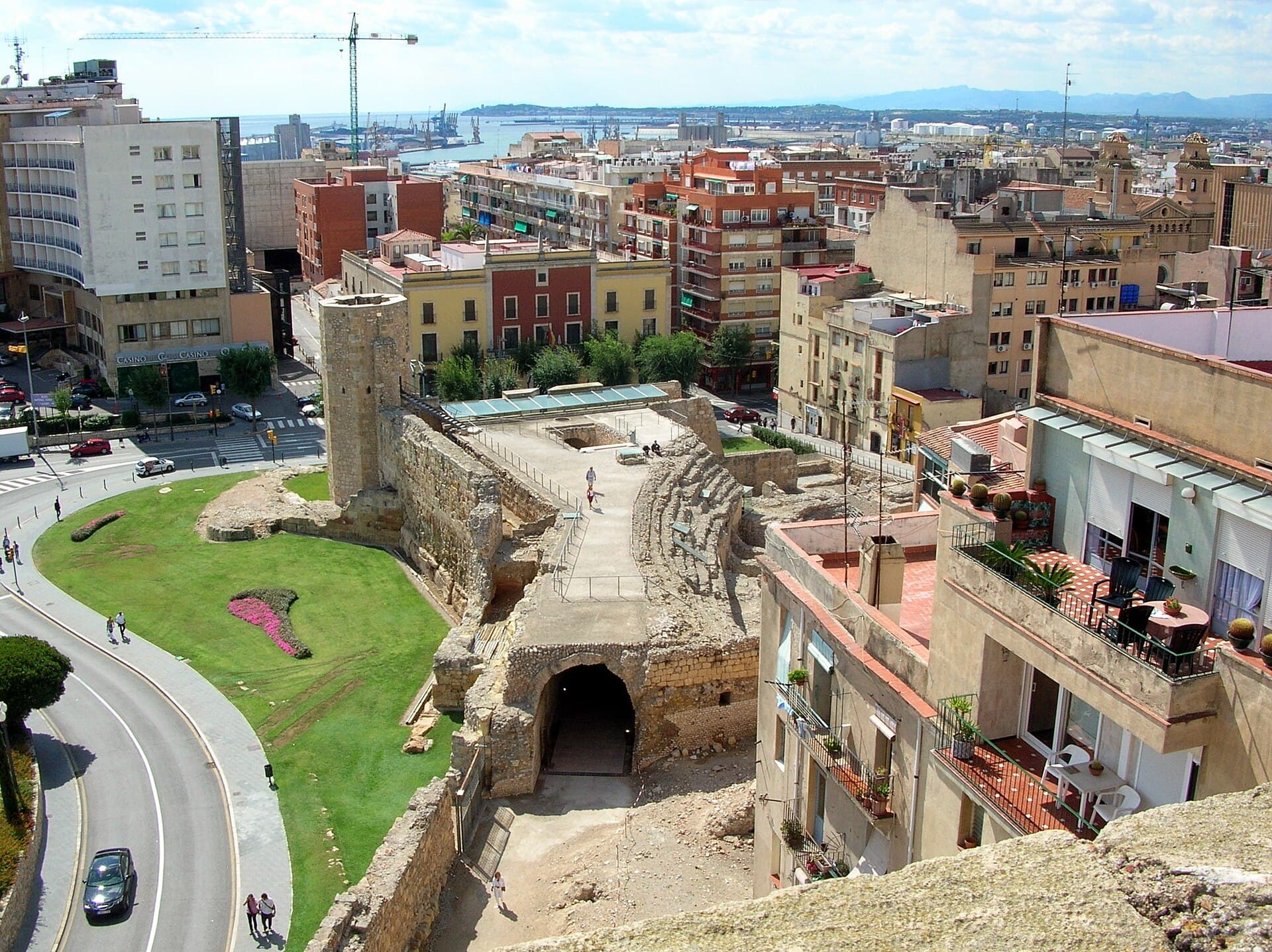
Photo: Bernard Gagnon · CC BY-SA 3.0 via Wikimedia Commons
Tarragona was Tarraco, capital of Hispania Citerior, and for a period one of the most important cities in the western Roman Empire. Roughly two thousand years later a remarkable amount of it is still standing, scattered through a working modern city of 140,000 people — which is what makes it interesting. This is not an archaeological park you visit and leave. People live among it.
Things to do in Tarragona
- Stand in the amphitheatre with the sea behind the arena
- Walk the vaulted passages of the Roman circus under the modern city
- Cross the top of the Les Ferreres aqueduct outside town
- Follow the Passeig Arqueològic along the ancient walls
- See the rat-funeral capital in the cathedral cloister
- Eat romesco de peix at the Serrallo fishing quarter
Each is expanded on below.
The Roman city
The amphitheatre
The best-known monument and rightly so: a second-century amphitheatre cut into the hillside directly above the sea, so the tiers of seating look out over the Mediterranean. It held around 14,000 spectators.
In the middle of the arena are the ruins of a Visigothic basilica and a later Romanesque church, built to mark the spot where the bishop Fructuosus and two deacons were burned alive in 259 AD. The layering of one religion's martyrdom site on top of another culture's entertainment venue is the whole history of the city in one view.
The circus and the praetorium
The Roman circus, where chariot races were held, is extraordinary because it runs underneath the modern city. You walk through vaulted passages and stairwells that were built into the substructure of the racing track and later absorbed into medieval buildings. Emerging onto the terrace of the praetorium tower at the end gives you the best overview of the old town.
The walls
The Passeig Arqueològic follows a stretch of the Roman defensive wall, some of it third century BC and among the oldest Roman construction outside Italy. The lower courses are enormous, irregular megalithic blocks; the neat Roman ashlar sits above them.
The archaeological museum
The Museu Nacional Arqueològic holds the mosaics, sculpture and everyday objects excavated from all of the above, including the very fine Medusa mosaic. It gives context that the standing ruins alone do not.
Les Ferreres aqueduct
Four kilometres outside the centre, the aqueduct known locally as the Pont del Diable — the Devil's Bridge — carries a channel 217 metres across a wooded valley on two tiers of arches, standing 27 metres at its highest point.
You can walk across the top along the original water channel, which is a strange and slightly vertiginous experience. It is free to visit and, unlike the more famous aqueduct at Segovia, usually quiet.
The medieval city
Tarragona's cathedral was begun in the twelfth century on the site of the Roman temple to Augustus, and it straddles the transition from Romanesque to Gothic — you can see the style change as your eye moves up the west front. The cloister is the highlight, with carved capitals including a much-photographed one depicting a funeral procession of rats.
The surrounding old town, Part Alta, is a compact grid of medieval lanes and small squares with good, unpretentious restaurants.
The coast
Tarragona has proper city beaches. Platja del Miracle sits immediately below the amphitheatre, and there is a long balcony walk — the Balcó del Mediterrani — where local tradition holds that you touch the iron railing for luck.
Nearby
PortAventura World is fifteen minutes down the coast, and the beach resorts of Salou and Cambrils are close by. It is entirely feasible to combine Roman ruins with a theme park or a beach afternoon.
When to visit
Spring and autumn are most comfortable — the ruins are exposed and Tarragona in August is hot. Late May brings Tarraco Viva, a Roman history festival with re-enactments staged in the actual monuments, which is the single best time to see the city.
In even-numbered years at the start of October, the city hosts the castells competition, where teams build human towers up to ten levels high. It is one of the most extraordinary things to watch in Catalonia.
Beyond the main sites
The Roman forum
The provincial forum was the administrative heart of Tarraco and covered a large part of what is now the upper town. What is visible today is a fragment — columns, foundations and a section of basilica — sitting in a sunken enclosure surrounded by apartment blocks. It is a small site but it makes the scale of the original city legible in a way the individual monuments do not.
The early Christian necropolis
One of the largest and best-preserved Roman burial grounds in the western Mediterranean, excavated in the early twentieth century during the construction of a tobacco factory. The associated museum holds sarcophagi, mosaics and grave goods, and it is consistently one of the quietest parts of the archaeological ensemble.
Centcelles
Five kilometres outside the city at Constantí, a late Roman villa with a domed mausoleum carrying one of the earliest and most important Christian mosaic cycles anywhere. It requires a short drive and it is very rarely busy.
Eating in Tarragona
This is Costa Daurada fishing country and the port at Serrallo, below the old town, still lands a working catch. The restaurants along the quay there are where locals eat fish, and they are noticeably better value than anything in the tourist streets around the cathedral.
The regional speciality is romesco, the almond, hazelnut and dried pepper sauce that originated with the fishermen of this coast and now appears across Catalan cooking. Ordering romesco de peix, the fish stew it was invented for, is the proper way to encounter it.
Getting to Tarragona from Barcelona
Tarragona is about 95 kilometres southwest of Barcelona, roughly 65 minutes on the AP-7.
Trains from Barcelona Sants take between one hour and ninety minutes depending on service. Note that high-speed AVE trains stop at Camp de Tarragona station, which is about ten kilometres outside the city and requires a connecting bus or taxi — a detail that catches people out. Regional trains go to the central station, which is a short walk from the amphitheatre.
Book your transfer to Tarragona
Private, door-to-door, with a fixed price agreed before you travel. From €140 per vehicle from El Prat Airport, excluding VAT and tolls.